
Love Under Watch
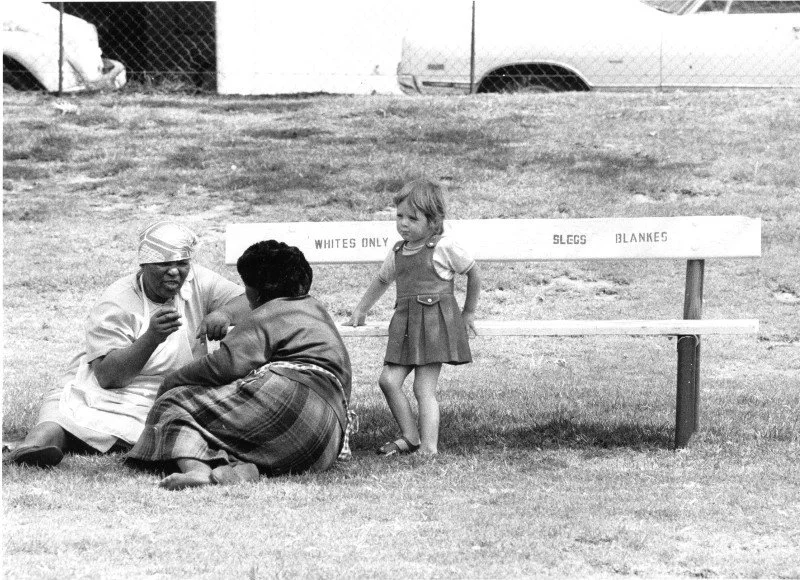
Audrey, Morgan, Elizabeth, Raka
Reading:
Jackson, Sebastian. “Miscegenation Madness: Interracial Intimacy and the Politics of ‘Purity’ in Twentieth-Century South Africa.” Du Bois Review: Social Science Research on Race 21.2 (2024): 223–249.
What is the purpose and main arguments of the article?
The purpose of “Miscegenation Madness” is to analyze how fear of interracial relationships became a central ideological foundation of apartheid in South Africa and how this fear shaped laws, social norms, and racial identities. Jackson argues that apartheid was not only enforced through political and economic systems, but also through emotional and psychological fears surrounding race, sexuality, and “purity.” He explains that anti-miscegenation laws and propaganda were meant to enforce racial hierarchies and uphold white supremacy by controlling bodies and reproduction. However, the article also shows that these taboos ultimately failed due to interracial desire and relationships continuing to exist, despite legal, social, and cultural repression and contradiction. Overall, the main argument is that the obsession with racial purity both sustained apartheid and revealed its instability, since the very desires it tried to suppress could never be fully governed or eliminated.
How does the article highlight or explore the course themes?
This article connects to our course theme of racism and science by showing how apartheid was justified through a mix of religious beliefs, pseudo-scientific theories, and radical ideology. Jackson explains that ideas of racial purity were often presented as scientific or biological, even though they were rooted in emotional fear and had no real evidence. At the same time, Christianity positioned White Protestants as divinely favored and held White men and women to the highest standards in society. Jackson also highlights how legislators, bureaucrats, and judges collaborated to construct “common sense” as a justification for Black inferiority. Rather than opposing one another, science and religion in South Africa were actively used together to support racial hierarchies and enforce discrimination under apartheid.
How would you describe the “vibe” of the text?
The “vibe” of this text is heavy. However, the author does not abandon the need for a scholarly and fact-based argument. The article addresses real suffering and injustice that the author is clearly critical of, but Jackson expresses his dismay toward the apartheid regime through valid, academic evidence. As the son of a white Dutch mother and Black American father, Jackson has a personal connection to key themes presented in the text, which subsequently influences the vibe of the text. The emotionally charged yet deliberately academic text results in an extremely effective argument that causes the reader to understand its moral gravity. Jackson is detail-oriented, focusing on archival evidence, laws, legal language, and police practices. He forms a meticulous argument that reveals the apartheid regime’s obsession with interracial sex and marriage. In revealing this fixation, the diligence of the article itself provides a parallel to the obsessive apartheid and thus causes the reader to feel and understand that fixation.
How does this playlist complement the vibes of the text (somatically, sonically, taste, tempo, genre)?
This playlist complements the vibes of the text by translating the historical analysis into an emotionally understood experience, making the politics and struggles of interracial relationships and oppression of apartheid felt instead of simply read about. Songs such as “Forbidden Games”, and “Does Your Mama Know About Me” speak to the secrecy and constant surveillance that interracial relationships were constantly under. “Society’s Child” and “Brother Louie” give stage sonically to the pressure of radicalized moral judgement, and “Give a Little Love” and “Asimbonanga” give more to the performance aspect of rebellion against apartheid oppression. “Killing in the Name” and “Fight Back” bring high tempo energy to outright anger to fight back. “Bad Romance” and “Tu Jo Mila” broaden the fight globally, showing how forbidden relationships are pathologized across cultures. The playlist, starting with affection for identity with “Brown Skin Girl”, goes from soft to aggressive, supporting Jackson’s claim that interracial relationships destabilized racial order both legally and socially.
How did each of you go about finding songs to include in the playlist?
In selecting songs for the playlist, we focused on the key themes/elements of the text and how these themes related to the course themes of the week. We wanted to embody both the vibe and purpose of the article through our song selections. We also wanted to highlight the struggles that resulted due to the apartheid regime through songs that called attention to adversity experienced in interracial relationships. Along with that, our playlist selections underscore the power of resistance, empowerment, and compassion.
Morgan chose songs that embodied themes of interracial love, empowerment, resistance, and protest the apartheid struggle.
Elizabeth selected songs that related to themes of miscegenation as well as protest songs that confronted injustice.
Raka’s song choices focused on miscegenation, as well as resistance and compassion.
Audrey chose songs that focus on interracial relationships and resistance to apartheid, specifically thinking about the societal reaction from these relationships and actions.
How did you decide on the order and transitions between each song, including how to begin and how to end?
In the order of this playlist, we wanted to tell a story. We start with “Brown Skin Girl,” a positive and uplifting song of affirmation and hope, to solidify the overall vibe of the playlist and how we envision the future. From there, we move straight to the first point of the text—interracial relationships and how they were viewed by society—with “Forbidden Games,” “Does Your Mama Know About Me,” “Society’s Child,” and “Brother Louie.” Then, we turn to the less story-driven lyrics of “Give a Little Love” and “Asimbonanga,” both of which had cultural ripples in actions rather than words. “Senzeni Na?” broadens the fight to collective oppression through racial governance, leading into more aggressive and confrontational songs like “Killing in the Name” and “Fight Back.” Finally, we end the playlist on a global level, with “Bad Romance” and “Tu Jo Mila” showing how forbidden love is fought worldwide.
Were there ethical concerns or debates that came up while creating this playlist?
An ethical concern in creating this playlist is how Sebastian Jackson’s personal experiences may have shaped the framework and interpretation of his article. As a Black/mixed man with a White Dutch mother and a Black American father, he embodies Du Bois’s concept of “double consciousness,” giving him critical insight into the contradictions of apartheid’s racial and sexual hierarchies. This perspective allows him to engage deeply with Afrikaner nationalist ideology and racial taboos, but it also raises questions about subjectivity and bias. Moreover, Jackson clearly states that this “research has certainly taken an emotional toll” on him and how he sees his “face reflected in its colonial past” (Jackson 227). His positionality influenced his choice of materials, his interpretation of archival silences, and the emotional significance he attributed to cases of racialized intimacy, such as Sonya’s forced abortion. Jackson’s perspective enriches the study but also underscores how a researcher’s experiences and identity can shape knowledge. In creating this playlist, it was crucial to acknowledge the article’s great sensitivity, given that Jackson’s personal experiences influenced his interpretations of interracial intimacy, racial fears, etc.